日本語
日本語  Deutsch
  English
  Español
  Français
  Português


Many women share similar experiences around the daily puzzle of activewear, but the reasons often go unnoticed. After reviewing 100 responses from mothers, students, and professionals, a clear pattern began to emerge — one that reveals how women are managing the practicalities of modern life today.
While fashion designers have spent years debating the necessity of pockets, women have been busy inventing their own solutions. Here is what the data uncovered about the creative, slightly chaotic, and surprisingly intimate ways we carry our phones when pockets are nowhere to be found.
Section 1 — The Core Pattern Emerging
What the Data Shows
When we asked 100 women where their phone lands when they are dressed in leggings, the results shattered the idea that there is one "right" way to wear a device. Instead of a single consensus, we found a map of the female body utilized as a high-tech utility belt.
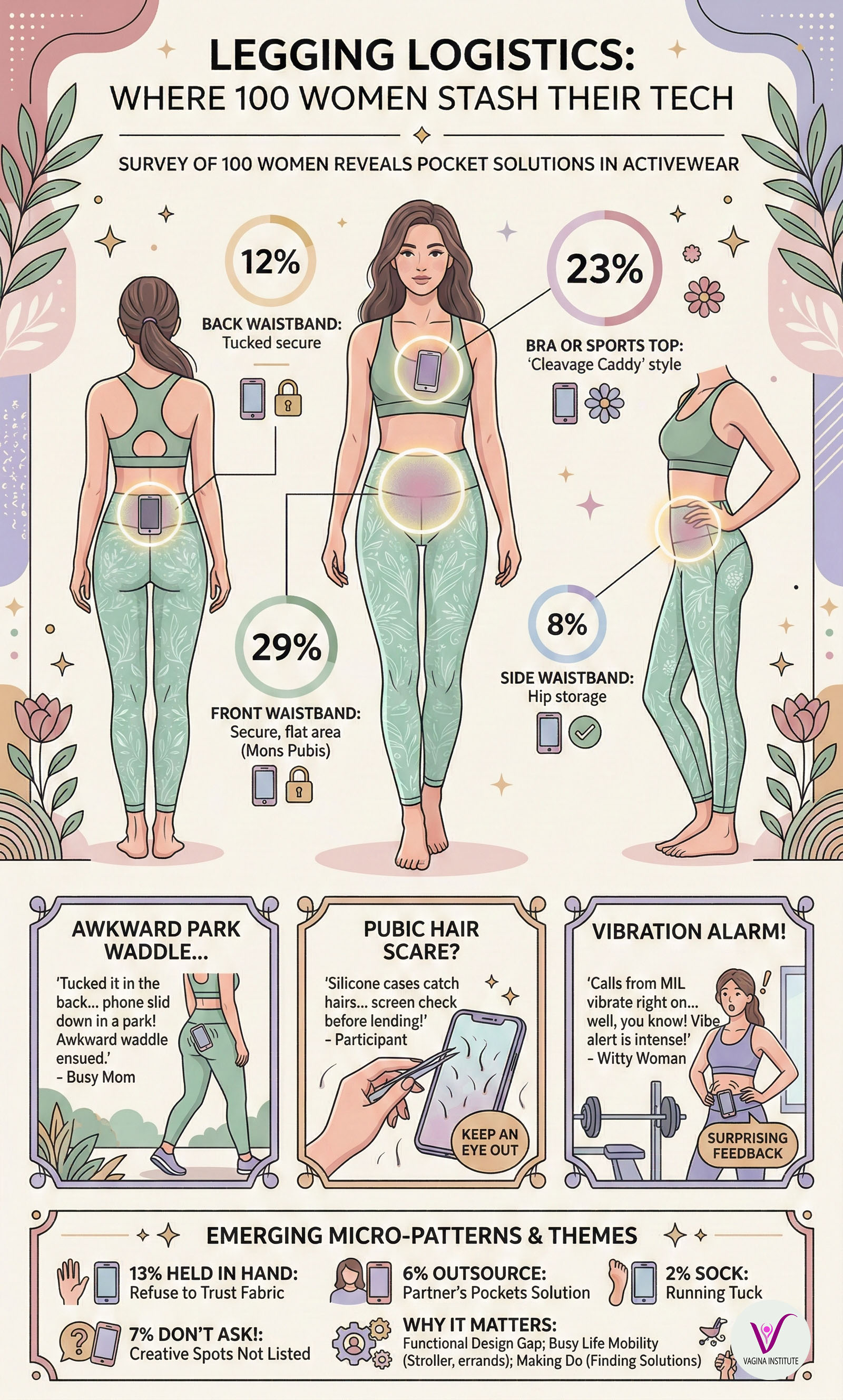
The most popular real estate isn’t a pocket at all. Topping the list at 29%, the most common storage solution is the front of the leggings, specifically tucked into the waistband against the mons pubis. This area provides a flat, stable surface where the tension of the fabric holds the phone securely against the body and underwear. Coming in a close second at 23% is the "cleavage caddy"—the classic move of sliding the phone directly into the bra or the top of a sports bra.
The data shows that for the modern woman, accessibility is secondary to security. We aren't just looking for a place to put the phone; we are looking for a place where it won't move while we are chasing a toddler or finishing a set of squats.
| Storage Location | Responses |
|---|---|
| Front Waistband (Mons Pubis) | 29 |
| Bra or Sports Top | 23 |
| Held in Hand | 13 |
| Back Waistband (Butt) | 12 |
| Side Waistband/Hip | 8 |
| "Don't Ask" / Hidden | 7 |
| Outsourced to Husband/Partner | 6 |
| Tucked in Sock | 2 |
Legging Logistics
Where do you stash your tech when you don't have pockets?
Section 2 — What Women Say (Key Qualitative Insights)
The Stories Behind the Numbers
The raw data tells us where, but the stories tell us how—and sometimes the "how" involves a bit of physical comedy. From the gym floor to the grocery store, women are making it work with varying degrees of success.
"I always tuck it into the back of my waistband, right over the tailbone," one mother shared. "It stays put while I'm walking, but I did have one terrifying moment at the park where it started to slide. Before I could grab it, it had slipped right down between my butt cheeks. I had to do a very awkward waddle to the bathroom to retrieve it without it hitting the pavement."
Other women noted that while the front-waistband (pubis) tuck is secure, it comes with unexpected sensory feedback.
"I keep it right up front against my pelvic bone. It’s the only place it doesn't bounce," another participant noted. "The only downside? When a call comes in and the vibration starts, it’s a... very sudden way to be alerted that your mother-in-law is calling."
There is also the matter of maintenance. A few participants pointed out the "grooming" hazards of these DIY holsters. One woman warned that rubberized protective cases are particularly grippy. On more than one occasion, she found a stray pubic hair or two caught between the case and her screen. It’s a helpful reminder: if a friend hands you her phone and she’s wearing pocketless leggings, you might want to check the corners.
🌿 Did You Know?
The "tuck and go" method comes with its own grooming hazards! Several women reported that rubberized phone cases act like magnets for stray hairs. If you're stashing your phone near your bikini line, a quick "screen inspection" is recommended before handing your phone to a friend to show them a photo!
Section 3 — Why This Pattern Matters
The Context Behind the Discovery
This behavior reveals a fundamental gap between garment design and the reality of a woman's day. For years, the fashion industry has prioritized the "silhouette"—the smooth, uninterrupted lines of a woman's figure—over the functional needs of the person wearing the clothes.
From a psychological perspective, these storage choices reflect a need for "hands-free" readiness. A mother needs her hands available for her children; a student needs them for coffee and books. By stashing the phone against the skin, women are reclaiming their mobility.
There is also a traditionalist element at play. Women have always been the masters of "making do." Much like our grandmothers might have tucked a handkerchief into a sleeve, the modern woman uses the tools at her disposal to keep her household and her life running smoothly. We are seeing a return to high-utility living, even if the "utility belt" is just a pair of high-compression spandex.
Section 4 — Emerging Micro-Patterns
Smaller Details Worth Noting
While the "Big Two" (waistband and bra) dominated the survey, several smaller groups showed how personality and situation dictate tech-placement:
- The Hand-Holders (13%): These women refuse to trust the fabric. Whether they’ve had a phone fall into a toilet or they just want instant access to their camera, they keep a literal grip on their digital lives.
- The Outsourcers (6%): A savvy group of women who simply hand the device to a husband, boyfriend, or child with actual pockets. It’s a partnership-based solution to a fashion-based problem.
- The "Don’t Ask" Group (7%): This segment suggests there are storage locations even more creative (or perhaps more questionable) than the ones listed. We can only assume these involve boots, hats, or perhaps very sturdy hairstyles.
- The Sock Slide (2%): A vanishing breed of runners who still swear by the ankle tuck, despite the risk of sweat damage.
Quick-Start: Stashing with Style
- ✅ Do: Use a smooth hardshell case to prevent friction against fabric.
- ✅ Do: Wipe your screen frequently if storing near the skin.
- ❌ Don't: Rely on thin, low-rise leggings for back-waistband storage (the "butt-slide" risk!).
- 🛠 Tools: Look for leggings specifically marketed as "squat-proof" for maximum tension.
Common Legging Logic Questions
Conclusion — What This Tells Us About Modern Womanhood
The discovery that nearly 30% of women are using their pelvic area as a phone holster might seem like a quirky bit of trivia, but it speaks to a deeper truth about the female experience. It shows a blend of pragmatism and adaptability. We take what is available—in this case, the tension of our clothing—and turn it into a solution for the demands of our busy lives.
Whether it’s a phone tucked into a bra or a device nestled against the hip, these habits represent a shared, silent language among women. We all know the struggle of the pocketless outfit, and we all have our "secret spots" to keep our essentials safe. It’s a small, funny, and very real part of being a woman today.
What this means for you
- Case Check: If you use the "front-tuck" method, consider a smooth hardshell case rather than a silicone one to avoid "snagging" issues.
- Safety First: If you are a back-waistband stasher, ensure your leggings have enough compression to prevent the "butt-slide" incident mentioned by our participants.
- The Borrowing Rule: Always look twice before grabbing a friend's phone if she’s just pulled it out of her leggings—honesty is the best policy!
Disclaimer: The articles and information provided by Genital Size are for informational and educational purposes only. This content is not intended to be a substitute for professional medical advice, diagnosis, or treatment. Always seek the advice of your physician or another qualified health provider with any questions you may have regarding a medical condition.