日本語
日本語  Deutsch
  English
  Español
  Français
  Português



There is a profound, quiet brilliance in the way a woman’s body communicates. Unlike the more immediate, visible nature of male arousal, a woman’s response is often likened to a slow-burning fire—one that requires the right conditions, the right fuel, and a deep understanding of the hearth.
For many women, the physical sensations of desire can feel like a mystery, yet they are governed by a sophisticated biological blueprint designed for connection, pleasure, and the continuation of life.
Understanding these signals is not merely about "fixing" a problem or checking a box in a relationship. It is about reclaiming an appreciation for the feminine design. When we strip away the modern noise and look at the hard science of our biology, we find a beautifully ordered system that thrives on safety, respect, and the natural dance between men and women.
The Physical Blueprint: More Than Meets the Eye
To understand arousal, we must first look at the anatomy that makes it possible. The female reproductive system is a masterpiece of vascular engineering. While the vagina is often the focal point of these discussions, it is only one part of a larger, interconnected network.
The Power of the Clitoris
The clitoris is the only organ in the human body dedicated exclusively to pleasure. While we see only the external glans, it is actually a large, wishbone-shaped structure that wraps around the vaginal canal. During arousal, this organ undergoes "tumescence"—it fills with blood, becoming firm and highly sensitive. This is the body’s way of signaling readiness.
Did You Know?
During peak arousal, the vagina actually undergoes a process called "tenting," where the cervix and uterus lift upward. This is your body's natural way of creating space and ensuring comfort during intimacy.
The Vaginal Response
As arousal progresses, the vagina undergoes two primary changes: vasocongestion and transudation. Vasocongestion is the rush of blood to the pelvic tissues, causing them to swell. Transudation is the process by which this increased blood pressure forces a clear, lubricating fluid through the vaginal walls. This isn't just a mechanical lubricant; it is a biological welcome mat, protecting the delicate tissues and ensuring that intimacy is comfortable and rewarding.
The Hormonal Conductor
A woman’s body does not exist in a vacuum. Our desire is inextricably linked to our endocrine system. Throughout a woman's monthly cycle, her "biological settings" shift, influenced by the rise and fall of estrogen, progesterone, and testosterone.
-
The Follicular Phase: As estrogen rises leading up to ovulation, many women report feeling more energetic, attractive, and interested in intimacy. Nature, in its wisdom, increases our receptivity when we are most fertile.
-
The Ovulatory Peak: During this window, testosterone (yes, women have it too!) often spikes, sharpening our physical focus and increasing the sensitivity of the skin.
-
The Luteal Phase: After ovulation, progesterone takes the lead. This is often a time of "nesting," where the body focuses on security and comfort rather than raw pursuit.
Recognizing these shifts allows a woman to stop wondering why she feels "on" one week and "off" the next. It isn't a flaw; it is a rhythm. By observing these patterns, a woman can better communicate her needs to her husband or partner, fostering a relationship built on reality rather than guesswork.
The Role of the Central Nervous System
If the pelvic organs are the instruments, the brain is the conductor. Arousal is governed by the autonomic nervous system, specifically the balance between the sympathetic (fight or flight) and parasympathetic (rest and digest) branches.
For a man, arousal can often break through stress. For a woman, the "off" switches are usually much more sensitive than the "on" switches. This is known as the Dual Control Model. We have an accelerator (things that excite us) and a brake (things that worry or distract us).
For most women, the "brakes" are powerful. A cluttered house, a looming deadline, or a lack of emotional security can keep the parasympathetic nervous system from engaging. This is why the traditional role of the man as a provider and protector remains so biologically relevant. When a woman feels that her environment is secure and her husband is dependable, her brain signals to her body that it is safe to move from "vigilance" to "vulnerability."
Infographic: The Dual Control Model
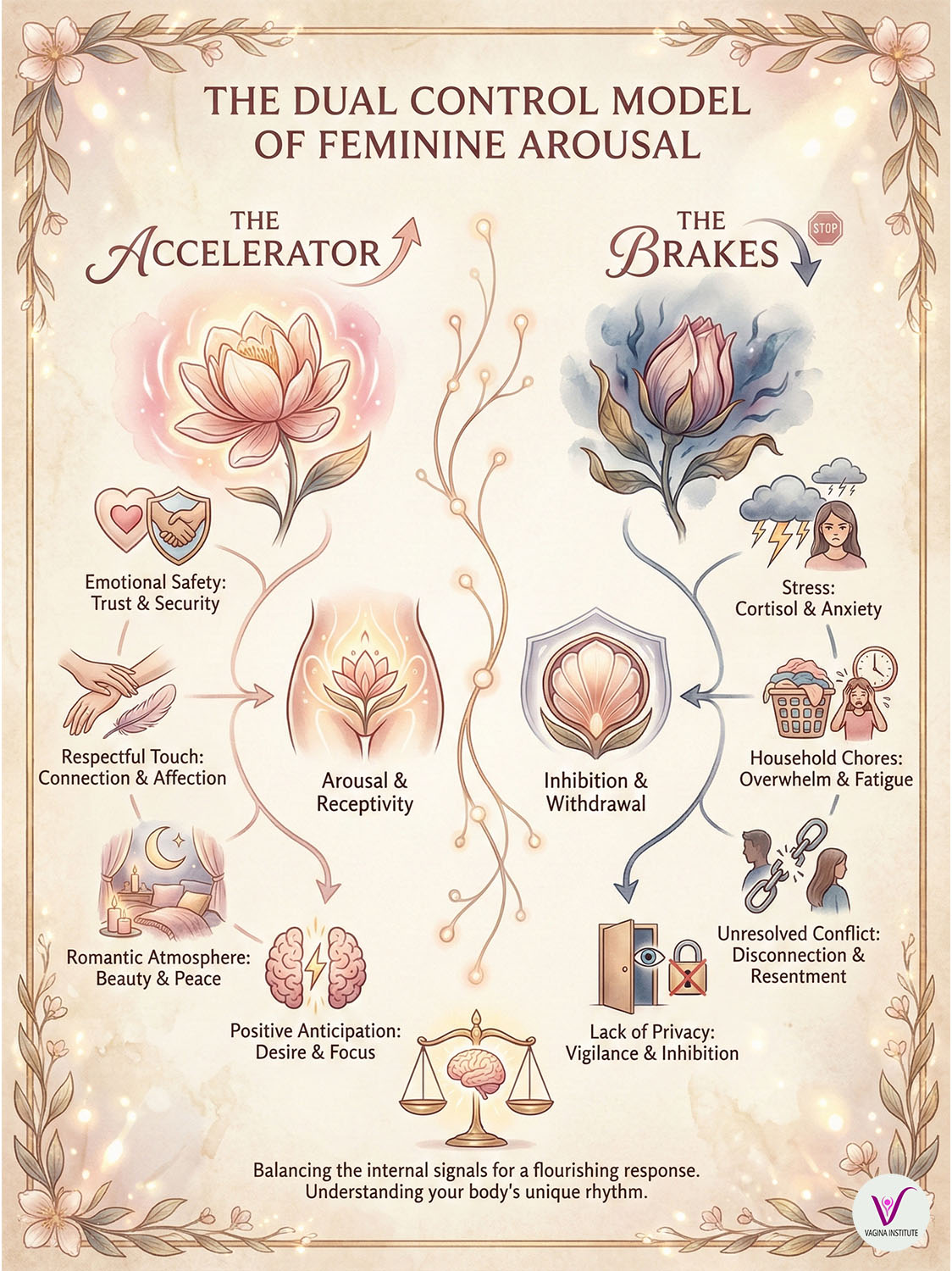
- The Accelerator: Emotional safety, respectful touch, romantic atmosphere.
- The Brakes: Stress, household chores, unresolved conflict, lack of privacy.
The Beautiful Difference: Men and Women
In contemporary discourse, there is a push to suggest that men and women are identical in their responses. However, science tells a different story. Men are generally more "vasocongestive" and visual. Their arousal is linear. Women, conversely, often experience "responsive desire."
Responsive desire means that a woman might not feel a spontaneous "itch" for intimacy while she is doing the grocery shopping or answering emails. Instead, her desire emerges in response to physical touch, romantic atmosphere, or the presence of a man she respects. Understanding this can remove the guilt many women feel when they don't experience a sudden bolt of lightning. The fire is there; it just needs a spark to start.
The Importance of Traditional Roles
There is a biological harmony in the traditional pairing of a masculine man and a feminine woman. A man’s strength and decisive nature often act as the "container" in which a woman’s softer, more receptive nature can flourish. When a man takes on the responsibility of the "pursuer"—offering courtship, stability, and physical protection—it allows the woman to transition out of her daily "manager" mode and into her feminine essence. This shift is often the greatest aphrodisiac of all.
The Signals: How to Read Your Body
Arousal is not an all-or-nothing event. It is a progression of signals. Recognizing these can help a woman stay present in her body.
| Phase | Physical Signal | Internal Experience |
|---|---|---|
| Excitement | Increased heart rate, light flushing of the skin. | A sense of warmth, increased focus on the partner. |
| Plateau | The "orgasmic platform" forms (swelling of the outer third of the vagina). | A feeling of fullness and intense sensitivity. |
| Resolution | Tissues return to their normal state; muscles relax. | Deep relaxation and a sense of emotional bonding. |
One of the most important signals is "tenting." As a woman becomes highly aroused, the inner two-thirds of the vagina actually expand and lift upward. This is a remarkable feat of biological engineering that prepares the body for the physical presence of a man, ensuring that the experience is one of union rather than friction.
Aesthetics and the Feminine Self
There is a deep connection between how a woman feels about her body and her ability to experience pleasure. In a world that often commodifies or distorts the female form, returning to a "Modern Traditional" view of beauty can be incredibly grounding.
Femininity is not about perfection; it is about radiance. When a woman cares for her body—not to meet an arbitrary social standard, but to honor her health and her husband—she often finds it easier to connect with her physical sensations. The vagina and the surrounding pelvic area are the core of our creative and reproductive power. Treating this part of the body with respect, cleanliness, and a sense of "sacredness" changes the internal narrative from one of shame or clinical coldness to one of appreciation.
Cultivating the Environment for Desire
If you find that your body’s signals are muted, it is rarely a biological "breakage." More often, it is a signal that the environment—either external or internal—is not conducive to the feminine response. Here are ways to honor the science of your arousal:
1. Prioritize Physical Peace
Since women require the "rest and digest" system to be active, physical comfort is paramount. This is why a clean, beautiful bedroom and a sense of privacy are not "extra" luxuries; they are biological facilitators.
2. Value the Emotional Bond
For a woman, the brain and the vagina are connected by the longest nerve in the body: the vagus nerve. This nerve is also tied to our emotional regulation. When there is conflict or a lack of trust with a husband, the vagus nerve can essentially "shut down" the physical response. Working on the marriage is, quite literally, working on your sex life.
3. Embrace the Slow Pace
Modern life is fast, but feminine arousal is slow. Allow yourself the time for the "warm-up." This isn't just about "foreplay" in the bedroom; it’s about the kind words, the shared look, and the hand held during a walk earlier in the day.
Common Questions About Arousal
The Goal: Integrated Intimacy
The science of arousal reminds us that we are not just a collection of parts, nor are we purely "intellectual" beings. We are integrated. Our hormones, our nerves, our anatomy, and our emotions all work together to create the experience of womanhood.
By understanding the mechanics of our bodies—the way the clitoris responds, the way the vagina prepares, and the way our brains require safety—we can move through the world with more confidence. We don't need to mimic male sexuality or follow modern scripts that ignore our natural design. Instead, we can lean into the beautiful, complex, and rewarding reality of being a woman.
In the end, the science of arousal is a testament to the way we were made: for connection, for joy, and for the deep, stabilizing bond of a traditional relationship. When we honor that design, our bodies respond in kind.
Disclaimer: This content is for informational and educational purposes only and does not constitute medical advice. It is not intended to be a substitute for professional diagnosis or treatment. Always consult with a qualified healthcare provider regarding any medical condition or treatment plan. Never disregard professional medical advice because of something you have read here.